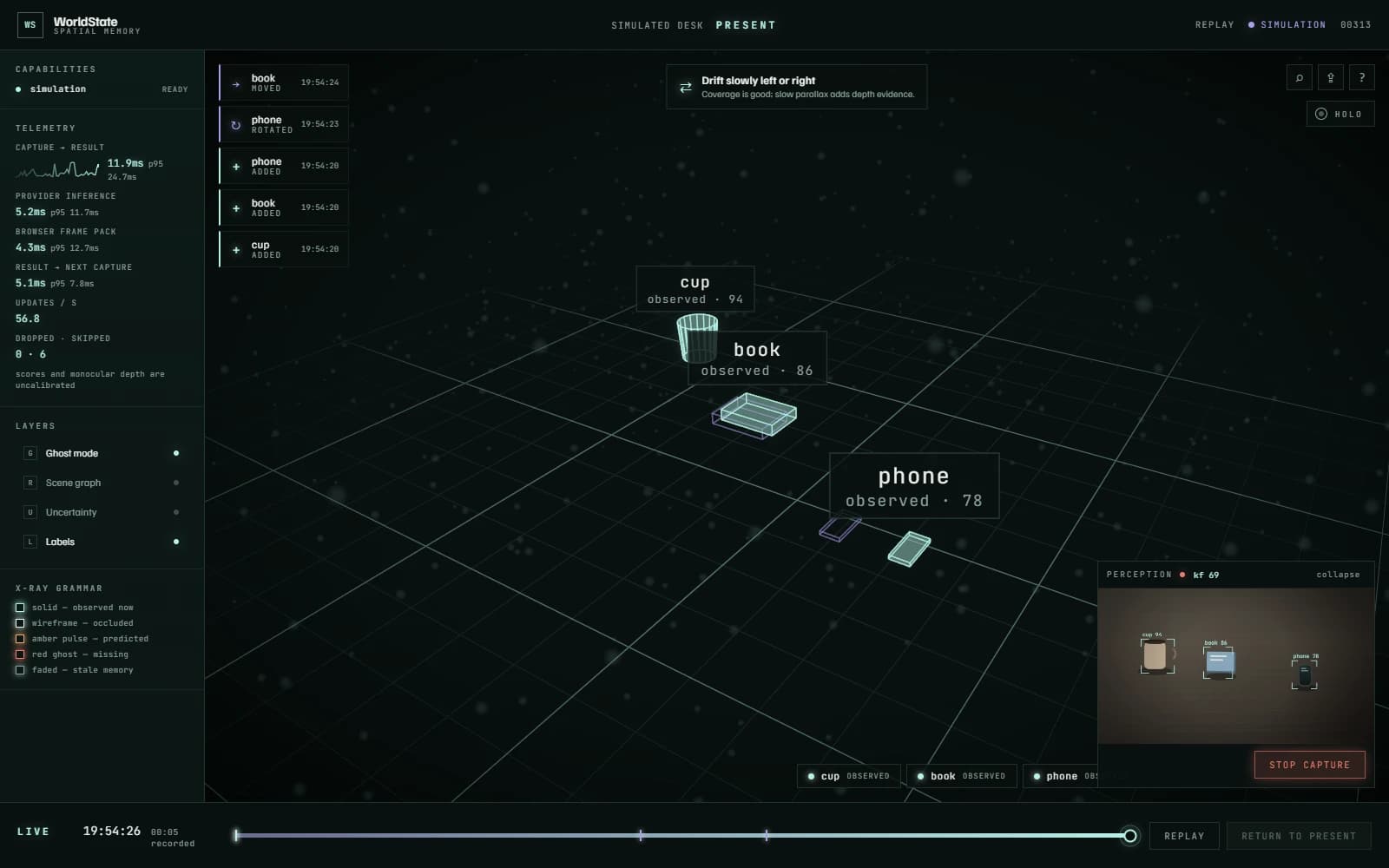
WorldState separates static geometry, movable objects, transient agents, and historical memory so a system can explain what exists, what changed, how certain it is, and which observations support the answer. The repository combines a FastAPI coordinator and framework-independent Python core with a React and Three.js spatial interface.
Stack, status, evidence, and public actions are rendered from the typed project record.
Category
AI Systems
Type
System
Priority
Flagship
Overview
What this project is
WorldState separates static geometry, movable objects, transient agents, and historical memory so a system can explain what exists, what changed, how certain it is, and which observations support the answer. The repository combines a FastAPI coordinator and framework-independent Python core with a React and Three.js spatial interface.
Problem
Why it matters
A camera feed is temporary. Once a frame disappears, ordinary vision interfaces cannot reliably explain what changed, where an object was last observed, or what evidence supports the current state.
Solution
Approach
A persistent world model that turns observations into spatial entities, temporal events, confidence, provenance, and a queryable history for one physical workspace.
Architecture
System shape and stack
Model
A workspace that remembers
WorldState models geometry, objects, agents, observations, and changes separately so the interface can show both the current scene and the evidence behind it.
Research Boundary
Claims follow reproducible evaluation
The project is an active technical prototype. Accuracy and performance claims remain bounded until labeled, reproducible evaluation supports them.
- Python
- FastAPI
- React
- TypeScript
- Three.js
- React Three Fiber
- XState
- Zustand
Technical Highlights
Visible technical signal
- Evidence-backed spatial state with provenance and uncertainty
- Separate live-camera and synthetic-replay boundaries
- Temporal tools for changes, object memory, scene history, and last-seen search
What It Proves
Builder signal
Product and systems thinking across computer vision, temporal data modeling, source isolation, spatial interfaces, uncertainty, and local-first architecture.