AWS Hack26 is a team-built maintenance decision-support demo. A Streamlit technician console connects synthetic AI4I observations to selectable scikit-learn operating policies, an original 3D machining-cell view, and local review records. An optional Amazon Bedrock integration selects supporting evidence for explanations.
Stack, status, evidence, and public actions are rendered from the typed project record.
Category
AI Systems
Type
System
Priority
Strong
Overview
What this project is
AWS Hack26 is a team-built maintenance decision-support demo. A Streamlit technician console connects synthetic AI4I observations to selectable scikit-learn operating policies, an original 3D machining-cell view, and local review records. An optional Amazon Bedrock integration selects supporting evidence for explanations.
Problem
Why it matters
A failure score alone does not tell a technician what evidence to inspect or how to record a review. Model tradeoffs and the limits of the data need to remain visible.
Solution
Approach
Connect reproducible model evaluation to a technician-facing console, retain the evidence behind each assessment, and save simulated review decisions without triggering real maintenance actions.
Architecture
System shape and stack
Evaluation
Choose policies on validation data
The benchmark compares five scikit-learn families on a fixed AI4I split. Operating policies fit on training data and choose thresholds and hybrid weights on validation data. Model identities distinguish cached explanations and simulated orders across policies.
Workflow
From assessment to recorded review
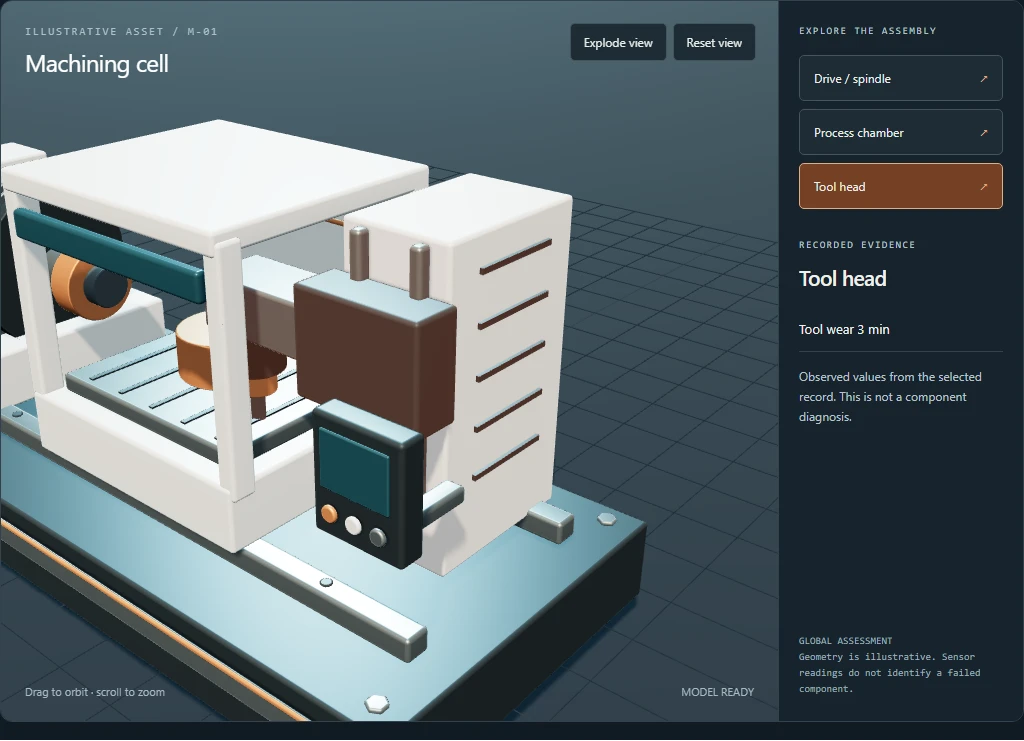
The console combines a 3D machining cell with evidence inspection and proposed follow-ups. SQLite stores simulated review dispositions and notes, rejects stale updates, and preserves review events.
Boundaries
A decision-support simulation
The active application uses classifier inference and deterministic workflow rules, with optional Bedrock evidence selection. It does not deploy an autonomous agent crew or dispatch machinery, technicians, or real work orders.
- Python
- Streamlit
- scikit-learn
- SQLite
- Amazon Bedrock
- Blender
Technical Highlights
Visible technical signal
- Five model families compared with explicit validation and test boundaries
- Selectable random forest, gradient boosting, and hybrid policies
- Persistent simulated reviews with concurrent-update protection
What It Proves
Builder signal
Applied ML evaluation, operator-focused interface design, persistent workflow engineering, and selective integration of a team-built demo.
Boundaries
Context that should stay visible
Team-built project. The public repository records selected teammate contributions and deferred prototypes. Model evaluation uses the synthetic UCI AI4I dataset.
Synthetic data and exploratory test comparisons do not establish industrial accuracy, calibrated failure probabilities, remaining useful life, or production deployment. Maintenance actions and review records are simulated.